Why Climbing Walls Are Replacing Treadmills
There was a time—not long ago—when the treadmill was the unquestioned centerpiece of any fitness space. Rows of machines, glowing consoles, and the quiet hum of repetition defined what it meant to “work out.” Developers budgeted for them. Architects designed around them. Operators relied on them.
That era is ending.
Not with a dramatic collapse, but with something far more decisive: irrelevance.
Today’s most successful fitness environments—whether in universities, corporate campuses, or luxury multifamily developments—are not built around passive exercise. They’re built around experience. And in that shift, the treadmill has become a relic of a previous fitness philosophy: isolated, linear, and increasingly disconnected from how people actually want to move.
Climbing walls are not just filling that gap—they’re redefining it.
The Problem with the Traditional Gym Amenity
The issue isn’t that treadmills don’t work. They do exactly what they were designed to do: provide a predictable, measurable cardiovascular workout.
The problem is that predictability no longer holds value.
In a market where 41% of consumers are actively reducing discretionary spending on recreation, fitness spaces are under pressure to justify their existence. A treadmill offers utility—but not differentiation. It doesn’t attract new users, and it doesn’t keep them engaged.
From a developer or operator perspective, that’s a critical failure.

The Hidden Costs of “Safe” Amenities
Traditional gym equipment carries a set of assumptions that no longer hold:
- High usage ≠ high retention
- Members may use treadmills, but they don’t stay because of them.
- Low risk ≠ high value
- Safe, familiar equipment doesn’t generate excitement—or word-of-mouth.
- Standardization ≠ competitiveness
- If every facility offers the same amenity, none of them stand out.
In other words, treadmills are no longer assets. They’re placeholders.
The Rise of Experiential Fitness
Modern fitness environments are evolving into what can best be described as hybrid lifestyle hubs—spaces that blend physical activity, social interaction, and identity.
This shift is not subtle. It’s structural.
Instead of asking, “What equipment do we need?” developers are asking:
- What will bring people into this space repeatedly?
- What will create community?
- What will differentiate this property in a crowded market?
Climbing answers all three.
Why Climbing Walls Change the Equation
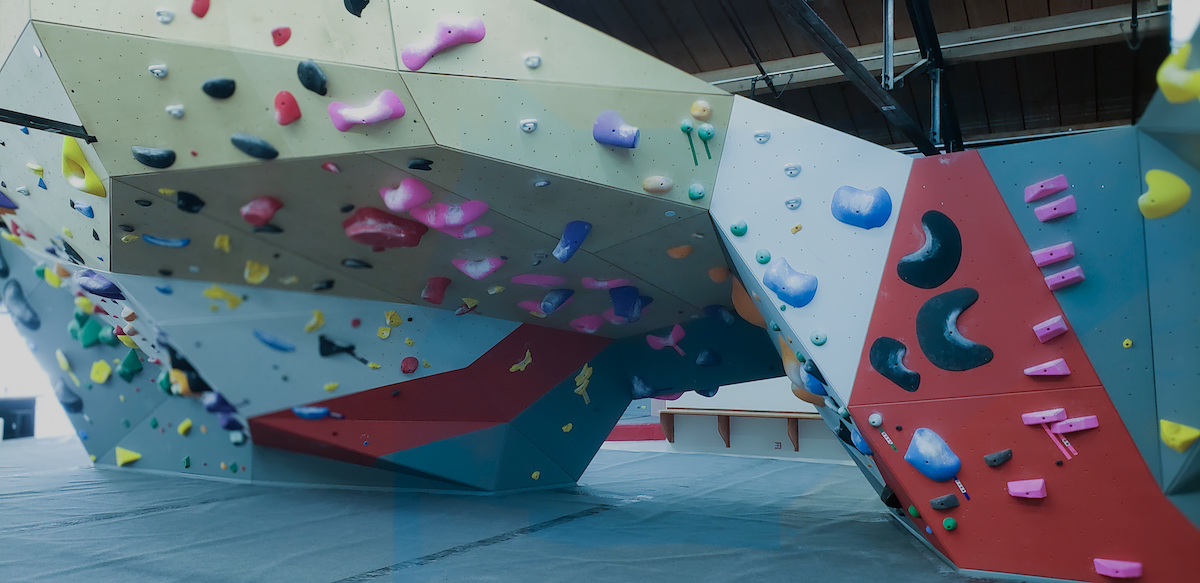
Climbing is not just another workout modality. It’s a fundamentally different category of experience—one that combines physical challenge, cognitive engagement, and social interaction in a single system.
1. Engagement Over Repetition
A treadmill offers a single movement pattern. Climbing offers infinite variation.
Every route is a problem to solve. Every attempt is different. This creates:
- Higher mental engagement
- Longer session times
- Repeat visitation driven by novelty
In a market where attention is one of the most valuable currencies, this matters.
2. Social Gravity
Traditional gym layouts isolate users. Climbing environments do the opposite.
They naturally create:
- Gathering points
- Shared challenges
- Observation and encouragement
- Organic interaction between users
This “social gravity” is one of the most underappreciated drivers of retention. People don’t return to spaces—they return to communities.
3. Visible Differentiation
A treadmill is invisible from a leasing tour. A climbing wall is not.
It becomes:
- A visual anchor in a building
- A conversation starter
- A marketing asset
In multifamily developments, this translates directly into:
- Increased tour-to-lease conversion
- Higher perceived value
- Stronger brand identity
In corporate settings, it signals something else entirely: innovation.
The ROI Shift: From Equipment to Experience
For decades, fitness ROI was calculated in terms of cost per unit and expected usage rates.
That model is outdated.
Today, ROI is driven by experience-based metrics:
- Retention rates
- Time spent in space
- Community engagement
- Brand differentiation
- Revenue diversification
Climbing walls outperform traditional equipment across all of them.
Throughput vs. Utilization
A single treadmill serves one user at a time. A climbing wall serves many—simultaneously and sequentially.
In high-traffic environments like universities or family entertainment centers, this translates into:
- More participants per square foot
- Lower idle time
- Greater revenue potential
This is why climbing infrastructure is increasingly being evaluated not as a cost, but as a profit center.
Universities: The Front Line of Change
Higher education has become one of the clearest indicators of where fitness design is heading.
Universities are not investing in climbing walls because they’re trendy. They’re investing because they solve real problems.
Mental Health and Cognitive Performance
Climbing engages the brain as much as the body. It requires:
- Decision-making under pressure
- Spatial awareness
- Problem-solving
Research has shown that this kind of activity improves executive function and reduces stress—two outcomes that are central to modern campus priorities.
Recruitment and Retention
Campus recreation centers are no longer just amenities. They’re recruitment tools.
A climbing wall signals:
- Investment in student well-being
- A modern, experiential campus culture
- Opportunities for community and leadership
In a competitive enrollment landscape, that signal matters.
Corporate Spaces: The New Wellness Standard
Corporate wellness has undergone a similar transformation.
The old model—rows of cardio equipment tucked into a corner—is being replaced by environments that actively support:
- Creativity
- Collaboration
- Stress reduction
Climbing aligns with all three.
From Burnout to Engagement
Short climbing sessions have been shown to:
- Improve focus
- Encourage risk-taking in a controlled environment
- Build trust through shared challenges
For companies competing for top talent, this is not a perk. It’s a strategy.
Multifamily Developments: The Amenity Arms Race
In residential real estate, amenities are no longer optional—they’re competitive weapons.
And the treadmill room is losing that battle.
The Shift Toward “Vertical Amenities”
Climbing walls offer something traditional amenities cannot:
- Memorability
- Differentiation
- Emotional impact
They transform a generic fitness center into a defining feature of the property.
Lease-Up and Renewal Impact
Properties that invest in experiential amenities consistently see:
- Faster lease-up periods
- Higher renewal rates
- Increased willingness to pay premium rents
Residents aren’t just renting space—they’re buying into a lifestyle.
The Psychology Behind the Shift
At its core, this transition is about more than fitness. It’s about how people relate to movement.
From Obligation to Play
Traditional gym equipment is often associated with obligation:
- “I should work out.”
- “I need to get my cardio in.”
Climbing reframes that entirely:
- “I want to try that route.”
- “I almost got it last time.”
This subtle shift—from obligation to play—is what drives long-term engagement.
The Risk Argument—and Why It’s Fading
One of the last strongholds of traditional gym design has been the perception of risk.
Treadmills feel safe. Climbing, at first glance, does not.
But modern climbing systems have evolved significantly:
- Auto-belay systems reduce staffing requirements
- Industry standards (ASTM, CWA) ensure consistent safety protocols
- Regular inspection frameworks mitigate liability
In many cases, the operational risk is not higher—just different.
And increasingly, developers are recognizing that perceived risk is outweighed by measurable value.
The Real Reason Treadmills Are Disappearing
It’s not because they stopped working.
It’s because they stopped mattering.
In a world where:
- Attention is scarce
- Experience drives decision-making
- Community determines retention
Static, individual, repetitive exercise no longer meets the bar.
Climbing does.
What This Means for Developers and Decision-Makers
If you’re planning a new facility—or reevaluating an existing one—the question is no longer whether to include fitness amenities.
It’s what kind.
The Strategic Shift
Forward-thinking projects are moving:
From:
- Equipment-based layouts
- Maximum unit density
- Passive user experiences
To:
- Experience-driven design
- High-impact focal points
- Active, social environments
Climbing walls sit at the center of that transition.
The Future of Fitness Spaces
The next generation of fitness environments will not be defined by how many machines they contain.
They will be defined by:
- How people interact within them
- How long they stay
- How often they return
- How strongly they associate the space with their identity
In that future, the treadmill doesn’t disappear entirely.
It just moves to the margins.
The Takeaway
The death of the traditional gym amenity isn’t about equipment—it’s about philosophy.
Fitness is no longer a solitary act of discipline. It’s a shared, immersive experience.
Climbing walls don’t just replace treadmills. They replace the entire idea of what a fitness space is supposed to be.
Build What People Actually Use
If you’re designing a facility that needs to perform—not just function—it’s time to rethink the role of your amenities.
→ Talk with our team about integrating a climbing wall into your next project
→ Request a feasibility analysis tailored to your space, audience, and ROI goals
→ Explore how RealRock™ and modular systems can transform your environment
Because the future of fitness isn’t flat.
It’s vertical.