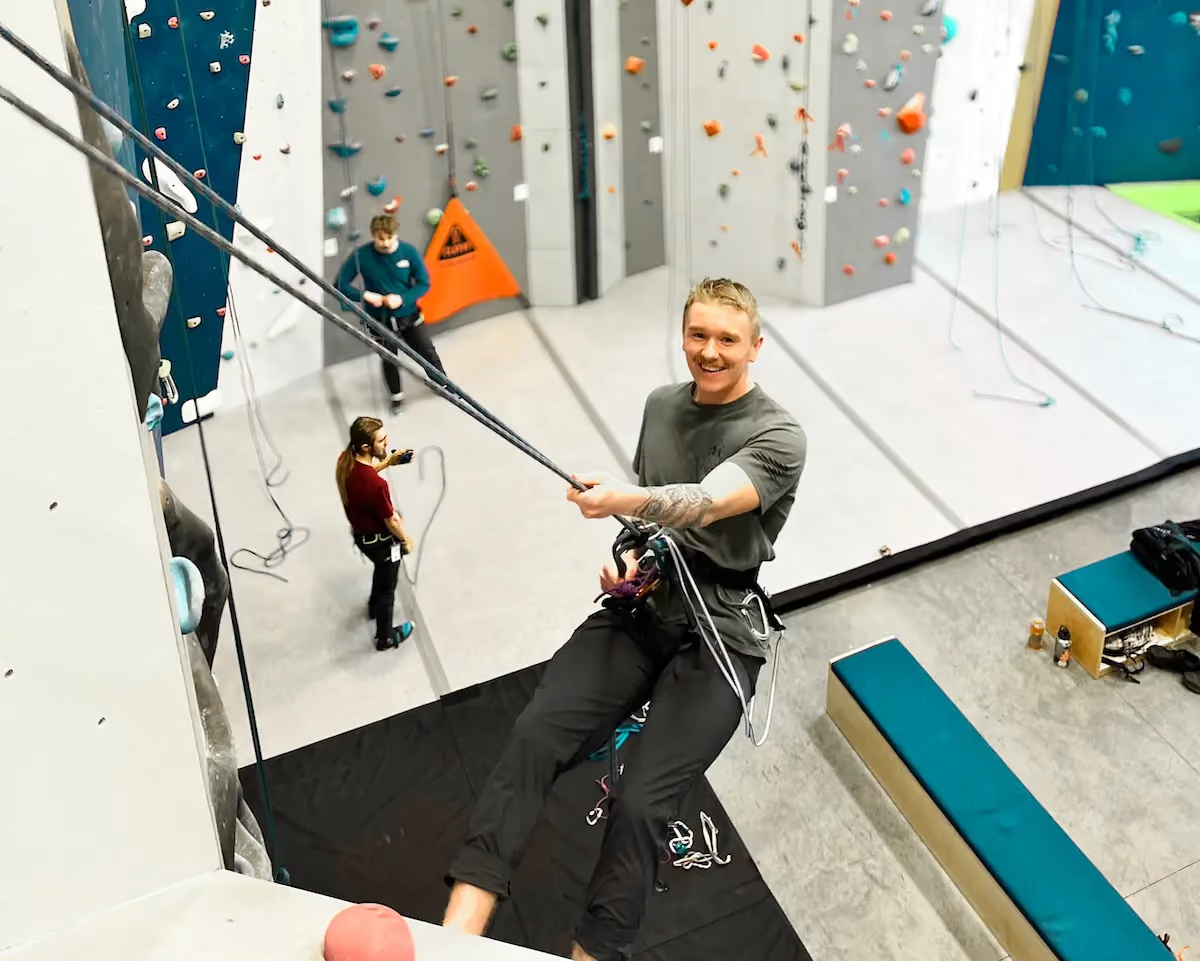
There’s a quiet shift happening on university campuses. It isn’t confined to lecture halls or traditional fitness centers. It’s happening in vertical space—on textured walls where movement becomes problem-solving and exercise starts to feel like presence.
Climbing walls are no longer a niche amenity for outdoor programs or elite athletes. They’ve evolved into high-impact wellness infrastructure—spaces that support physical fitness, mental health, social connection, and student retention. For campus leaders navigating rising expectations around student well-being, the climbing wall is no longer just recreational.
It’s a cornerstone of modern campus wellness.
The Expanding Definition of Campus Wellness
For decades, university wellness initiatives focused primarily on physical health: cardio equipment, weight rooms, and organized sports. Today’s students arrive with a far more complex set of needs. Rising levels of anxiety, loneliness, and academic pressure have forced institutions to rethink what “wellness” actually means.
Wellness is no longer just about burning calories. It’s about:
- Mental resilience
- Social belonging
- Cognitive performance
- Emotional regulation
This broader definition demands environments that engage the whole person. Climbing walls meet that demand in a way few other campus amenities can.
They don’t just offer activity—they offer immersion.
Movement as Mindfulness
One of the most compelling benefits of climbing is its inherent demand for focus. Unlike more passive workouts—where attention drifts between sets or screens—climbing requires full cognitive engagement.
Each route presents a problem:
- Where is the next hold?
- How should you shift your weight?
- What sequence will get you to the top?
This constant decision-making creates a state often described as “flow”—a form of active mindfulness where distractions fall away, and attention sharpens.
For students, this has measurable implications:
- Reduced stress and anxiety
- Improved emotional regulation
- A break from digital overstimulation
In an environment where attention is fragmented and mental fatigue is common, climbing provides something rare: a structured escape that restores focus rather than depletes it.
Cognitive Benefits That Extend Beyond the Wall
Climbing is often framed as a physical activity, but its cognitive demands are equally significant. Route planning, pattern recognition, and real-time adjustment all engage executive function—the same mental processes students rely on for academic success.
This includes:
- Problem-solving under pressure
- Working memory
- Adaptability and flexible thinking
Unlike traditional studying, which can feel abstract or repetitive, climbing embeds these skills in a physical, immediate context. The feedback loop is instant: a move either works or it doesn’t. Progress is visible. Failure is instructive.
Over time, this builds a kind of mental resilience that carries into the classroom. Students become more comfortable navigating complexity, more willing to attempt difficult tasks, and more capable of recovering from setbacks.
In other words, climbing doesn’t just train the body—it trains the way students think.
Social Connection in a Fragmented Campus Landscape
One of the less obvious—but arguably most important—functions of a climbing wall is its ability to foster organic social interaction.
Traditional fitness environments can be isolating: headphones in, eyes down, minimal interaction. Climbing flips that dynamic.
Between attempts, climbers rest. They watch others. They offer beta (advice on how to complete a route). Conversations emerge naturally:
- “Have you tried that move with your left foot?”
- “That route’s harder than it looks.”
- “Nice send.”
These micro-interactions accumulate into something larger: a community built on shared challenge and mutual support.
For new students—especially those struggling to find their place—this matters. Climbing spaces create low-pressure environments where connection doesn’t require formal introduction or high social confidence. It emerges through participation.
This aligns with a broader principle of campus wellness: belonging isn’t programmed—it’s facilitated.
Building Confidence Through Measurable Progress
There’s a particular kind of confidence that comes from climbing. It isn’t abstract or performative—it’s earned through incremental progress.
A student might fall off a route five times before completing it. On the sixth attempt, something clicks: a better foothold, a more efficient sequence, a moment of commitment.
They reach the top.
That experience—failing, adjusting, succeeding—builds:
- Self-efficacy
- Persistence
- Trust in one’s own capability
Unlike many academic or social environments, where feedback can be delayed or ambiguous, climbing provides immediate, tangible evidence of growth.
For students navigating uncertainty—academically, socially, or personally—this kind of feedback is powerful. It reinforces a simple but transformative idea:
Progress is possible.
The Belay Relationship: Trust in Practice
In roped climbing environments, the relationship between climber and belayer introduces another dimension of wellness: trust.
The climber depends on the belayer for safety. The belayer must remain attentive, responsive, and reliable. It’s a partnership built on communication and responsibility.
This dynamic fosters:
- Accountability
- Leadership
- Interpersonal trust
For student employees working in campus recreation, these roles extend further. Managing climbing facilities, instructing peers, and overseeing safety protocols all contribute to real-world skill development.
Climbing walls become training ground—not just for physical ability, but for leadership and teamwork.
Supporting Mental Health at Scale
University counseling centers are under increasing pressure. Demand for mental health services continues to rise, often outpacing available resources. While climbing isn’t a replacement for clinical care, it serves as a powerful complementary tool.
It offers:
- A proactive outlet for stress
- A structured environment for emotional release
- A community that reduces isolation
Importantly, it does so without stigma. Students don’t visit the climbing wall because they’re struggling—they visit because it’s engaging, social, and fun. The mental health benefits are embedded in the experience.
This makes climbing uniquely scalable as a wellness intervention. It reaches students who might never seek traditional support, integrating mental health into everyday campus life.
A Competitive Edge in Student Recruitment
Campus amenities play a growing role in how prospective students evaluate universities. Recreation centers, in particular, have become key differentiators.
Climbing walls stand out in this landscape.
They signal:
- Innovation in campus design
- Commitment to holistic wellness
- Investment in student experience
For prospective students and their families, a well-designed climbing facility communicates something beyond its physical presence. It suggests a campus that values exploration, challenge, and community.
In an increasingly competitive enrollment environment, these signals matter. They influence campus tours, application decisions, and ultimately, enrollment outcomes.
Retention Through Engagement
Recruitment is only part of the equation. Retention—the ability to keep students engaged and enrolled—is equally critical.
Climbing walls contribute to retention by increasing what might be called “campus stickiness.” Students who feel connected to a space, a community, or a routine are more likely to remain engaged with their institution.
Climbing supports this through:
- Habit formation (regular visits, progression tracking)
- Community integration (friendships, shared experiences)
- Identity development (seeing oneself as a climber, a participant, a member)
These factors create emotional ties to the campus environment. And emotional ties are what sustain long-term engagement.
Inclusivity and Accessibility in Vertical Space
Modern climbing walls are increasingly designed with inclusivity in mind. Adaptive climbing programs, varied route difficulties, and thoughtful spatial design allow a broader range of students to participate.
This includes:
- Beginners with no prior experience
- Students with physical or cognitive differences
- Individuals who may not feel comfortable in traditional athletic settings
Climbing’s modular nature makes it uniquely adaptable. Routes can be adjusted. Holds can be repositioned. Experiences can be tailored.
This flexibility supports a more inclusive vision of wellness—one that meets students where they are, rather than expecting them to conform to a fixed standard.
The Climbing Wall as a Campus Hub
At their best, climbing facilities become more than standalone features. They evolve into hubs—spaces where multiple aspects of campus life intersect.
They host:
- Student organization events
- Introductory clinics and workshops
- Competitions and social gatherings
They integrate with:
- Outdoor recreation programs
- Leadership development initiatives
- Wellness campaigns
In this role, the climbing wall becomes connective tissue—linking different parts of the campus experience into a cohesive whole.
Designing for Long-Term Impact
For universities considering the addition or expansion of a climbing wall, the conversation should move beyond square footage and cost. The real question isn’t “What does it take to build this?” but “What does this enable over time?”
A well-designed climbing facility supports:
- Years of student engagement
- Evolving programming and use cases
- Integration with broader wellness strategies
It becomes infrastructure in the truest sense—not just a feature, but a foundation.
From Recreation to Essential Infrastructure
The perception of climbing walls is changing. What was once considered an optional amenity is now increasingly viewed as essential to a modern campus.
This shift reflects a deeper understanding of student needs:
- Wellness is multidimensional
- Engagement drives retention
- Community supports mental health
Climbing walls address all three.
They offer a rare combination of physical challenge, cognitive engagement, and social connection—delivered in a format that is both accessible and compelling.
The Strategic Opportunity for Universities
For campus decision-makers, the implications are clear. Investing in climbing infrastructure isn’t simply about adding variety to a recreation center. It’s about aligning with the future of student wellness.
It’s about creating spaces that:
- Support mental health without stigma
- Foster community without force
- Build resilience through experience
Ultimately, it’s about designing campuses where students don’t just succeed academically, but thrive as whole individuals.
The future of campus wellness isn’t flat. It’s vertical—and it’s already reshaping how students move, connect, and grow.